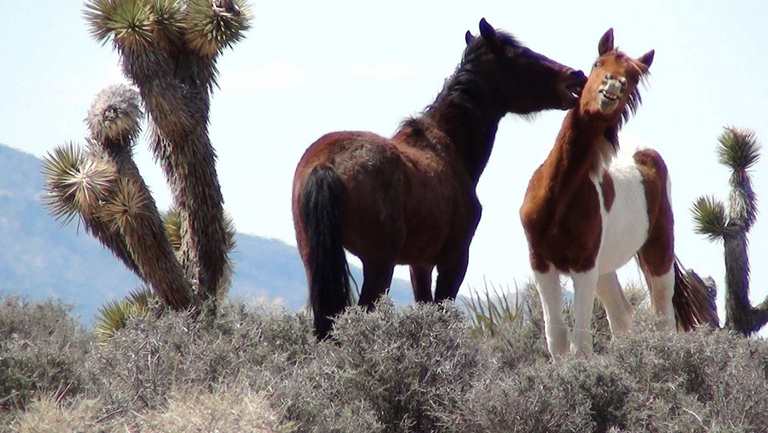
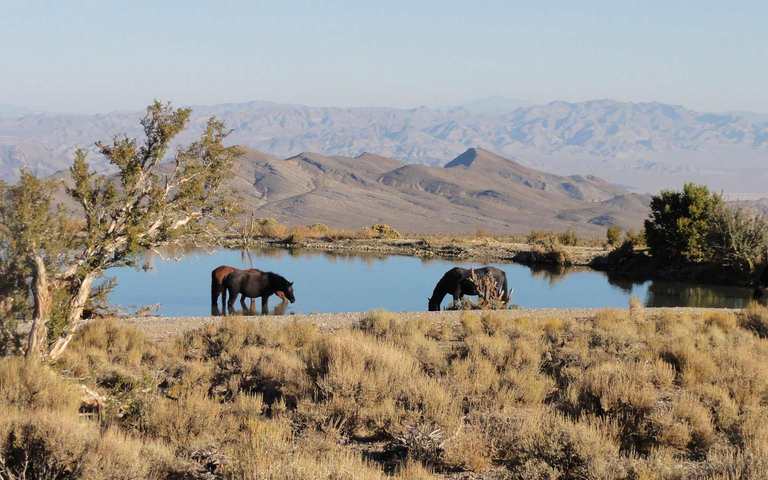
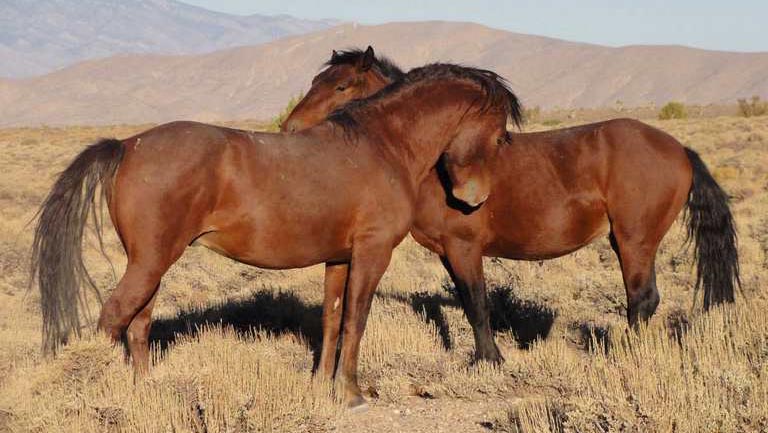
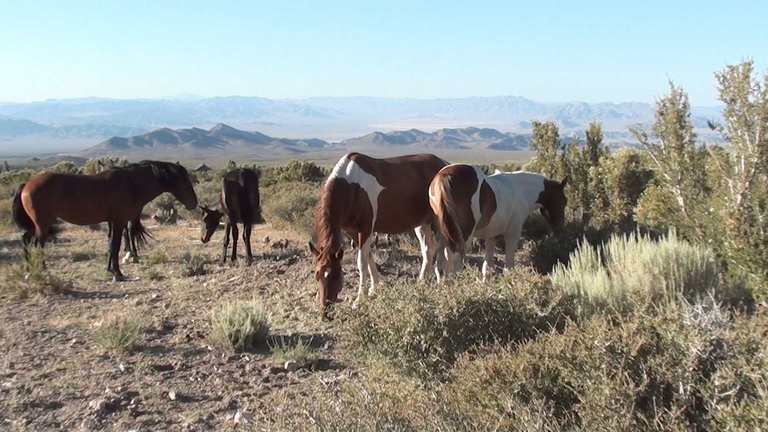
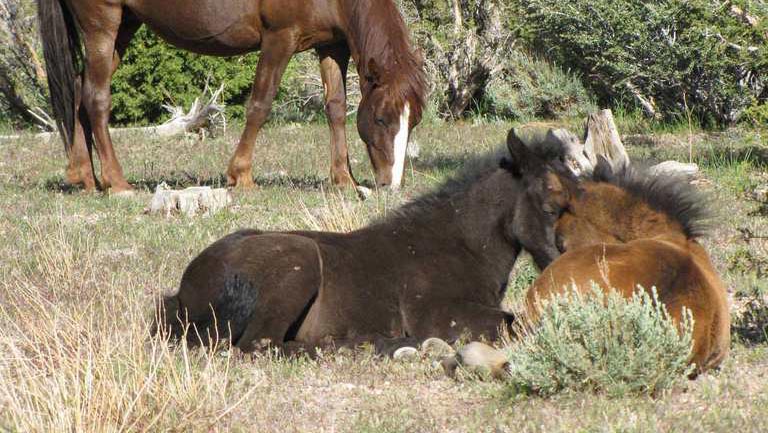
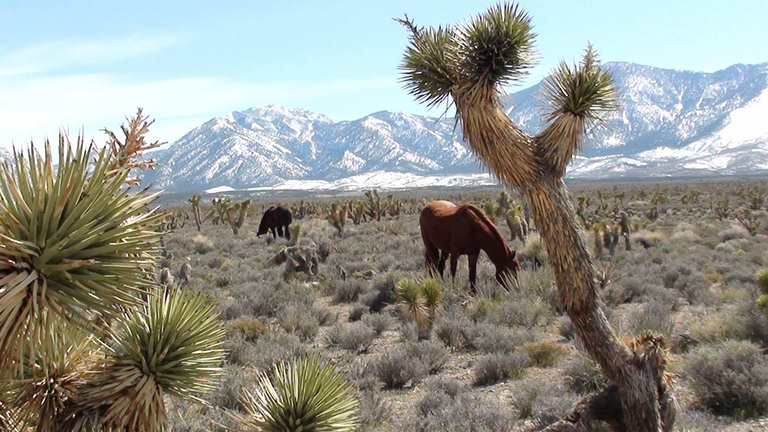
Something extraordinary happens to your spirit when you see wild horses slip out of a forest or gallop across a mesa. Come view these horses who bring a landscape alive with their freedom, energy and spirit. Without them, our world will be diminished.
To search for reviews of scientific publications concerning wild horses, you can go to any of the following websites and find different but valuable information. In the search bar, put wild horse and go to findings.
http://www.ncbi.nlm.nih.gov/pubmed/
PubMed comprises more than 21 million citations for biomedical literature from MEDLINE, life science journals and online books.
http://www.sciencemag.org/search
SCIENCE is the world’s leading Journal of original scientific research, global news and commentary. It is a peer-reviewed journal of the American Association for the Advancement of Science and has an estimated readership of one million people.
NATURE is the chief competitor to SCIENCE and enjoys a huge readership as well. There is overlap of material but each needs to be consulted for full information.
FROM THOSE SITES, HERE ARE SOME REVIEWS OF INTEREST REGARDING WILD HORSES:
Science 23 September 2011:
Vol. 333 no. 6050 pp. 1710-1711
DOI: 10.1126/science.1212452
Ecology
Coexisting with Cattle
+ Author Affiliations Department of Wildland Resources, Utah State University, Logan, UT 84322, USA.
E-mail: johan.dutoit@usu.edu
Summary
Many large plant-eating mammals have evolved to live in multispecies assemblages, with species competing for food and other resources. Through domestication and animal husbandry, however, humans have enabled a few species of livestock, such as cattle, to dominate such assemblages. One standard practice in livestock production on rangelands, espoused by commercial ranchers and subsistence pastoralists alike, is the eradication of large, indigenous herbivores that are believed to compete with livestock for food. These eradication efforts have increasingly problematic implications for biodiversity conservation (1). So it is timely that on page 1753 of this issue, Odadi et al. (2) report on a relatively simple experiment that tested the assumption that cattle and wildlife compete for food. Their study, conducted in an East African savanna renowned for its large herbivore diversity, revealed that cattle do compete with herbivores such as zebras and gazelles during the dry season, when food quantity is low. In contrast, during the wet season, when food quantity is high, grazing by wildlife benefits cattle by improving the quality of forage. The findings highlight ecological processes that promote coexistence among large herbivores in grasslands and savannas, and hence could be useful for conservation.
More… http://www.sciencemag.org/content/333/6050/1710.summary
********************
Am J Reprod Immunol. 2011 Jul;66(1):40-50. doi: 10.1111/j.1600-0897.2011.01003.x. Epub 2011 Apr 19.
Contraceptive vaccines for wildlife: a review.
Kirkpatrick JF, Lyda RO, Frank KM.
Source
The Science and Conservation Center, ZooMontana, 2100 South Shiloh Road, Billings, MT 59106, USA. jkirkpatrick@montana.net
Abstract
Wildlife, free-ranging and captive, poses and causes serious population problems not unlike those encountered with human overpopulation. Traditional lethal control programs, however, are not always legal, wise, safe, or publicly acceptable; thus, alternative approaches are necessary. Immunocontraception of free-ranging wildlife has reached the management level, with success across a large variety of species. Thus far, the immunocontraceptive research and management applications emphasis have been centered on porcine zona pellucida and gonadotropin-releasing hormone vaccines. Contraceptive success has been achieved in more than 85 different wildlife species, at the level of both the individual animal and the population. At the population management level with free-ranging species, the primary focus has been on wild horses, urban deer, bison, and African elephants. The challenges in the development and application of vaccine-based wildlife contraceptives are diverse and include differences in efficacy across species, safety of vaccines during pregnancy, the development of novel delivery systems for wild and wary free-ranging animals, and the constraints of certain non-contraceptive effects, such as effects on behavior. Beyond the constraints imposed by the public and a host of regulatory concerns, there exists a real limitation for funding of well-designed programs that apply this type of fertility control.
© 2011 John Wiley & Sons A/S. PMID: 21501279 [PubMed - indexed for MEDLINE]
More… http://www.ncbi.nlm.nih.gov/pubmed/21501279
***************************
2010 Oct 26;5(10):e13635.
Immunocontraception in wild horses (Equus caballus) extends reproductive cycling beyond the normal breeding season.
Nuñez CM, Adelman JS, Rubenstein DI.
Source
Department of Ecology and Evolutionary Biology, Princeton University, Princeton, New Jersey, United States of America. cmvnunez@princeton.edu
Abstract
BACKGROUND:
Although the physiological effects of immunocontraceptive treatment with porcine zona pellucida (PZP) have been well studied, little is known about PZP's effects on the scheduling of reproductive cycling. Recent behavioral research has suggested that recipients of PZP extend the receptive breeding period into what is normally the non-breeding season.
METHODOLOGY/PRINCIPAL FINDINGS:
To determine if this is the case, we compiled foaling data from wild horses (Equus caballus) living on Shackleford Banks, North Carolina for 4 years pre- and 8 years post-contraception management with PZP (pre-contraception, n = 65 births from 45 mares; post-contraception, n = 97 births from 46 mares). Gestation lasts approximately 11-12 months in wild horses, placing conception at approximately 11.5 months prior to birth. Since the contraception program began in January 2000, foaling has occurred over a significantly broader range than it had before the contraception program. Foaling in PZP recipients (n = 45 births from 27 mares) has consistently occurred over a broader range than has foaling in non-recipients (n = 52 births from 19 mares). In addition, current recipients of PZP foaled later in the year than did prior recipient and non-recipient mares. Females receiving more consecutive PZP applications gave birth later in the season than did females receiving fewer applications. Finally, the efficacy of PZP declined with increasing consecutive applications before reaching 100% after five consecutive applications.
CONCLUSIONS/SIGNIFICANCE:
For a gregarious species such as the horse, the extension of reproductive cycling into the fall months has important social consequences, including decreased group stability and the extension of male reproductive behavior. In addition, reproductive cycling into the fall months could have long-term effects on foal survivorship. Managers should consider these factors before enacting immunocontraceptive programs in new populations. We suggest minor alterations to management strategies to help alleviate such unintended effects in new populations.
PMID: 21049017 [PubMed - indexed for MEDLINE] PMCID: PMC2964306 Free PMC Article

When you are tracking wild horses, look for well-worn pathways through the scrub and grasslands. Horses, likeelephants and antelope, prefer to follow trails they know – these are easily spotted from a high ridge or a waterhole.
Look for stud piles where passing stallions will pooh on top of the pile year after year. It is a territorial statement and usually the most dominant stallion will defecate last. Perhaps when stallions sniff the pile, they test the testosterone level of their rivals or determine when rivals last moved through the area.
Where you find fresh dung, scan the horizon and the scrub with binoculars looking for bright color or any movement. Just a whisk of a tail can alert you to wild ones.
Watch for dusty areas cleared of scrub where horses roll to get rid of biting insects. Now that is a picture to get! Quickly have your camera ready because rolling doesn’t last long and as soon as they are on their
feet, horses give a quick shake – that dust cloud is gorgeous especially if the sun is behind the wild ones.
Learn to read wild horses’ signals and you can get some stunning action shots – or quickly get out of the way of danger.
Band members communicate with subtle sounds and postures. A soft whinny may call in scattered band members or rambunctious foals at play. A snort can be a gentle warning or protest. A scream will instantly alert the whole band to take action as one body.
Wild horses – like all prey species – have great hearing and sense of smell. If you see one or two horses lift their heads and flare their nostrils, look in the direction of their ears are pointing. You may spot an intruding stallion or a predator like a bear – that is just enough warning to get your camera ready for explosive action.
Wild horses may appear to ignore you, but watch their ears. One ear will be cocked in your direction, while the other ear points elsewhere. Unlike domestic horses, they’ll keep an eye or ear on you until they prove that you are no threat so don’t chatter to your fellow humans. Stay quiet like a wild horse.
Do not approach wild horses directly because they will instinctively move away. Flight is their best weapon against a hunter. So meander toward them indirectly.
Predators stalking horses & burros lock their gaze on their prey so don’t stare at a wild horse’s eyes. Look somewhere else and keep your head low – submission please.
If a band of horses looks nervous, you might sit or kneel down until they relax.
A stallion may circle around to get a good look at you and can charge if he feels you are a threat. Usually he will pull up short in the nick of time, but meanwhile the band will disappear and your photography will end right there so don’t push it.
Always carry good binoculars and use your camera’s telephoto lens so you can enjoy their behavior without getting close enough to frighten them off.
Always keep a comfortable distance from wild horses. By law that is 10 feet in the heavily visited Chincoteague herds on Assateague Island in Maryland & Virginia. Even a simple camera has a good telephoto range so rely on it to get safe shots.
Do not feed wild horses. If you are foolish enough to offer a wild horse a treat, a senior or dominant mare may punish it with a kick or bite – and your body may be in the way. Don’t meddle in their social structure or the alpha horse may teach you a painful lesson.
Wild horses don’t normally behave dangerously toward people. However, they do startle easily and may suddenly kick out or run. Over a thousand pounds of frightened horse can hurt you without meaning to.
When you first spy a wild horse band, look closely at the horses to see if they are a group of stallions – that is called a bachelor band.
A band is a close social group that moves together for mutual protection but also for companionship. Wild horses are social herd animals. Some have been known to lose interest in life and stop eating when separated from key band members.
A bachelor band offers both companionship and protection to immature stallions, injured stallions that need to recover from battle wounds, and senior stallions that can no longer fight off mature challengers.
Young males are usually driven from their family bands by the age of 3 when they become more sexually active. This prevents inbreeding with their direct relatives.
Sometimes a band stallion will permit his son or stepson to stay longer than normal in the family band – as an assistant protecting the herd and intimidating challengers. Eventually the son will seek his own mares but for years afterward they cordially greet each other at waterholes and pastures which makes for great photographs.
Friendly band stallions greet each other with arched necks, sniffing of muzzles and soft squeals. They may even graze their bands in proximity. Watch for these friendships when you see several bands calmly approaching each other.
Two horses that have been apart usually greet by touching their soft muzzles and inhaling each other’s breath. Watch to see what they do next. Sometimes they may squeal, paw, kick or move quickly apart. Why? Unfortunately we don’t have years of scientific observation to explain this so you can build your own observations.
Watch closely when a stallion sniffs fresh horse droppings or urine and then curls back his upper lip. He draws scent molecules across his vomeronasal organ at the roof of his mouth.
All cats, buffalo, antelope, giraffes, llamas and horses do this quick chemical test called flehmen. This tells him how long ago another animal passed by or whether a female is in heat or estrous, meaning she is ready to breed.
A lead stallion may violently “capture” mares from other bands but a mare will leave his band if she dislikes the stallion’s or another band mare’s behavior toward her.
Gentle courtship can sometimes last for days with the stallion following the mare, grooming her and bonding closely.
When a stallion wants to drive his mares and foals away from danger – or another stallion – he snakes them by lowering his neck, flattening his ears, stretching out his head low to the ground and twisting it as he chases his family away from danger.
When a stallion is snaking his band, he can raise his head just a bit and they will respond by slowing down and relaxing – the signal is very subtle so watch closely.
A family band – sometimes called a harem – usually numbers 2 to 4 mares and their offspring. Yearlings and 2-year olds play on the edge of the band but young foals cling close to their mothers.
Each family band has a lead mare, normally the oldest and/or most trusted mare. She chooses when and where they move for water, graze or flee from danger.
When you see a family band of mares, foals and a stallion, stay long enough with them to learn their hierarchy – a lead mare normally has highest seniority and the shorter the time a mare has been in the band, the less seniority she and her foal may have.
If you see a mare flatten its ears back, nip or kick at a younger horse, try to see what she is teaching it. It may need to learn quick obedience or it might fall prey to a hunter. It may be playing too roughly with a younger foal or too close to a cliff edge. Mares have life experience to teach and that gives you superb photographs.
Dominant bands and dominant mares and stallions usually drink first at water. You may think that’s unfair when all the horses are very thirsty but a family band needs the most experienced horses to survive.
Subordinate horses benefit from their wisdom and protection and they feel safer with a strong leader. Now you are learning to think like a wild horse.
Submission is quickly shown to a superior by lowering of a head, tucking tail between its legs, and clacking of teeth. Have your camera ready to record a chastised foal who licks and clacks its’ teeth toward its superior.
Its elder may groom it to re-establish their social bond much like a human parent will tousle a child’s hair or straighten its’ clothes after a hard scolding.
When danger threatens, the band stallion brings up the rear. It is his job to fend off predators while his lead mare guides the others to safety. It is also his job to be on guard when the mares and foals are grazing.
Band mares can forge close ties that will outlast their allegiance to any stallion. Sometimes the loss of a preferred companion can cause depression in a wild horse and it may leave its band. The band may dissolve occasionally due to this first loss.
In some areas such as the red desert of Wyoming, bands of multiple stallions and mares stayed together longer than one stallion family bands (miller 1981). Perhaps sharing protection duties preserved the stallions’ strength but more scientific observation needs to be done on the reason for this multiple stallion banding.
Mares carry their foals for 11 months. Most foals are born in April to early June so they have time to put on size and weight before winter’s lean grazing. They cling to their mother’s side when very young which is ideal for picture-taking.
A wild mare will nurse her foal through winter and if she does not have a new foal the next year, she will let her yearling nurse until it is very big.
If grazing or water conditions are poor, band stallions will usually breed only one or two senior mares, thereby reducing the population in hard times.
If you spot a heavily pregnant mare with swollen or dripping teats, follow her band quietly from a distance. You may be fortunate to experience a birth.
Her stallion stands guard while another mare usually stays close by. Other band members appear to graze quietly but the entire family is really on alert for danger.
Within minutes of birth, the mother or her assistant – the auntie – will encourage the newborn to stand. It will totter, all legs and large head, and may quickly collapse but it can walk confidently within 1 hour of birth and run within 2-3 hours.
A newborn foal will nudge its mother’s side or chest, instinctively seeking milk. She may step away from the foal just to get the foal active quickly.
When the foal locates its mother’s teats swollen with rich milk, it grips on and pushes up on a teat to start the flow of milk.
If you miss that photo of its first drink, just wait as the foal often moves over to the other side of mom to drink at the second teat.
Very soon after drinking, a young foal may collapse in a tangle of long legs and nod off to sleep. The band will graze around it letting it rebuild its energy.
A foal’s nap could be short so take your pictures quickly.
In hot treeless range, a pair of mares may stand head to head over a sleeping foal to give it shade. This increases the social bonds between band members and is a wonderful scene to photograph.
A mother’s bond to her foal is based on its unique scent early on. However, a mare may accept an orphaned foal particularly if she has lost her own foal.
Young foals are superb subjects especially when they suddenly run away, spin and dash back to their mothers. Always keep your camera or binoculars focused on them. Foals and yearlings will mock fight and play mount each other practicing for their adult life. Set your camera for shooting multiple frames a second!
Wild horses & burros – like zebra and antelope – groom each other’s back and withers. This mutual or allo-grooming strengthens their social bonds while getting rid of flies and ticks in hard to reach places. Zoom in close on their relaxed, content faces.
By chasing off immature stallions, a band stallion may keep his daughters from breeding until they are 3. Stable family bands actually reduce the birth rate this way.
Even if a very young mare runs off with a tempting stallion, the family band will welcome her back if she finds he cannot protect her. Like young zebra mares, she may “try out” several stallions before settling into a stable band.
When stable family bands are broken up by government roundups, the birth rate may increase partly because mares are no longer protected from the immature stallions.
If a wild horse population needs to be limited, it is better to bait a single family band into a temporary pen and dart some of the mares with the inexpensive and non-hormonal contraceptive, PZP (porcine zona pellucida).
Some yearlings may be removed for adoption and a few band members radio-collared for further study. The family band is then released into their established range.
After foals are born in spring, mares come into estrous within a month although they may not conceive at this first breeding. The stallions are on high alert at this time, challenging each other for breeding access. You’ll be challenged to photograph it all.
Stallions will posture before risking an injury in a serious fight. They will challenge each other by snorting, flaring their nostrils, standing proud, arching their testosterone-thick necks, pawing the air, rearing and squealing.
If no one gives ground, they will bite, strike and kick at each other. Stay out of their way and rely on your telephoto lens to get close-up images of a fight.
A serious battle between stallions is both awesome and terrifying. They will rear and fall onto the other stallion’s neck or back, kneel down and bite the other’s legs, or slash their body sometimes tearing open a deep gash or even ripping off an ear.
The weaker stallion will run away but he usually heals quickly from the deepest of wounds. He may join a bachelor herd during this time of recovery.
A stallion’s scars may even signal his seriousness to other stallions and prevent them from challenging him. We need graduate students studying bands over a number of years to truly know the dynamics of stallion challenges.
Wild horses living naturally tend to be stronger and live much longer than domestic horses – often to 30 or 40 years. Even if they have an old injury, arthritis or blindness, the herd will protect and lead them.
You can easily spot very old wild horses in the band, by white hairs around their eyes and muzzles, prominent back and hip bones, and bony rib cages. But make no mistake; these elders are still strong and wise, an asset to a family band.
Look at the hooves of wild horses – lots of movement over rough ground and rock keeps them naturally trimmed and strong. They are sure-footed on rocky hillsides.
Many horse owners have learned to leave their domestic horses’ hooves trimmed but “barefoot” so the horse feels the ground better and has more flex in its stride.
Wild horses come in a wonderful variety of colors. A bay has a light to dark brown body usually with a black mane and tail.
Black horses are common in the wild and may wear a spot of white as a star, blaze or snip above their nose or between their eyes. White may mark one or more legs.
Pintos are wonderful to photograph against solid color horses in their band. They may have sorrel, dun or black spots over a white coat. The patterns are varied and fascinating.
A sorrel is reddish brown and its mane and tail are usually the same color as its body.
A buckskin has a pale yellow, cream or gold body and dark mane and markings.
A palomino is golden white, and its mane is usually creamy or white. Its’ body darkens in summer and often as it ages.
A dun or grulla or grullo (pronounced grew-yah or grew-yo) has a dun gene that means some hairs have less pigment. They always have a dark dorsal stripe from the withers down the back.
Duns or grullas may have other markings like zebra stripes on their legs, sometimes a light color or frosting on top of a dark mane, dark shading on the neck, forehead, muzzle or eyes and perhaps a dark shoulder stripe across the withers.
The dun gene is characteristic of Iberian (Spanish) bloodlines. They do not have white hairs in their coat like roan horses.
A roan has a mottled coat with white hairs equally intermingled with another color like bay, black or sorrel giving them a bluish tone or a reddish tone. Their coats may darken or lighten in winter. Their legs and mane are usually darker, free of white hairs.
Curly wild horses can most easily be found in northwestern Nevada. A unique gene causes the hair to curl and their winter coat curls tightest. They are hypoallergenic which pleases horse lovers with allergies.
Curlies are extremely hardy in the wild. The plains Indians like the Sioux prized them and rode them at the battle of little bighorn.
White or gray horses are common in the wild. An albino is all white with pink eyes – it lacks pigmentation.
A cremello is an albino horse but does not have pink eyes. A cremello’s coat whitens in winter and may go dark in summer.
Both of these albino types lack dark pigmentation around the eyes suffer from weepy and swollen eyes in bright sunlight. They may go blind in midlife.
Blind horses can survive well in the wild as they “friend up” with a companion horse or band that gently guides them even when being run over rough terrain by a predator or man.
Wild horses are highly mobile or nomadic, grazing from 5 to 10 miles from water a day. Wild horses take a bite of grass or bushes then take a few steps before foraging again. You won’t see them beat down a section of land if they are free to move on.
Wild horses prefer grasses – dry or green – but they will browse bushes sometimes whereas deer and elk prefer to browse on bushes like sage or bitterbrush. There really is no direct competition between them on a healthy range.
Wild horse bands each have a home range that may overlap. They can be 5 to 35 square miles or more depending on the quality and density of the vegetation. If you have the good fortune to live near wild horses, follow a few bands and learn their home ranges.
Wild horses are extraordinary survivors. For example, they can graze at higher elevations, on steeper slopes, and in more rugged terrain than domestic cattle.
Severe drought or extreme weather can damage the graze and health of wild horses but even extremely thin or weak horses recover their weight and strength quickly when rains green the landscape.
In summer, wild horses prefer to move to higher elevations like mountain meadows where they can find fresh water and abundant green grass.
They may be hidden in forest canopies so you should patiently scan ridges and shadows with binoculars to find wild horse bands at rest in the shade.
In winter, you will find the wild bands at lower elevations below the heavy snow line. They may browse on scrub brush and bark as well as dry grass in order to keep their calorie intake at acceptable levels.
Wild horses can eat snow in place of water.
In icy winds and damp, wild horses seek windbreaks in a stand of trees or by cliffs. In open land, they lie down between sage and scrub to get out of the wind.
Wild horses are comfortable sleeping lying down but usually one horse stands guard.
In winter, the horses’ shaggy coats protect them from heavy wind, rain or snow. In spring, you’ll laugh at the raggedy coats with clumps of hair coming off on bushes.
By summer, wild horses will be sleek and shiny – a joy to photograph.
On a warm day at a waterhole, watch for a few horses that begin to paw the water – be quick to photograph them plunging in to soak their coats and fly bites in mud.
Wild horses mud-bathing can dig the waterhole deeper and compact the bottom so it holds more water for all wildlife.
Wild horses will only strip a rangeland of vegetation where human fences interrupt their natural movement. Unfortunately that is now more common than open range. An example is the 2010 forestry dep’t fence across the Pryor mountain range in Colorado.
Wild horses do have many natural predators: mountain lions, wolves & bears even coyotes or bobcats can take a newborn. For instance, in 2004 only 1 out of 28 foals survived in Montana’s Pryor Mountains mostly due to mountain lion predation.
Many deaths result from injuries & miscarriages, lightning & extreme weather. Lightning kills horses each summer in higher elevations – a complete band may be struck and killed on the mountainsides.
Occasionally a young foal may be injured or killed in a violent battle between competing stallions. A young stallion driven off from his band may not find the safety of companions before being attacked by a mountain lion.
When the U.S. gov’t removed all wild horses from coyote canyon in Anza Borrega Nat’l Park (California) to increase the number of bighorn sheep – popular with game hunters – bighorn deaths skyrocketed because cougars no longer fed on horse foals.
Wild horses are true gardeners of the land – scientific studies have shown that horses actually benefit the range in numerous ways.
Watch how wild horses clip the tops of grass allowing it to easily grow back while opening up the lower story to sunlight and faster growth. Antelope prefer to dine on that lower, richer grass level which results in complementary feeding.
Because cows don’t have upper teeth, they have to wrap their tongues around and pull grass out slowing its regrowth.Western watersheds project acknowledges that "the main cause of degradation of public lands in the arid west is livestock use and not wild horses."
Wild horses will devour cheat grass (drooping broom or bromus tectorum) the invasive weed that thrives where livestock have overgrazed the native. They serve as firemen of western pastures since cheat grass feeds hot wildfires.
Wild horses do not thoroughly digest the food they eat, like the cud-chewers – deer, elk, cows and sheep. Plant seeds pass undegraded through a horse’s gut and are “re-planted” in rich manure – just like the elephants do for native plants in Africa.
The nutrient rich droppings of wild horses help the soil absorb and retain water for other plants and animals. Flammable vegetation is reduced. In the 1950’s, the first wild horse protection law in the nation was passed in Storey County, Nevada, primarily out of concern over brush fires.
Wild horses help other wildlife survive in winter by breaking through deep snow to find grasses and using their powerful hooves to break ice on frozen water sources.
Long ago, buffalo survived hard winters by following the wild horse movements. In the great blizzard of 1886, many of the cattle that survived on the Great Plains followed herds of mustangs to eat where they opened up the snow drifts.
Estimates are disputed but less than 22,000 horses still roam wild in America – down from perhaps 3 million in the 1700’s. Thus far, no objective, scientific surveys of wild horse populations have been done by any government agency.
Ten western states still have wild horses on public land: Arizona, California, Colorado, Idaho, Montana, Nevada, New Mexico, Oregon, Utah And Wyoming.
Nevada can be the leading state for wild horses viewing as it has more horses than any other single American state. However gov’t agencies are steadily removing them.
Fifty million years ago, a short, dog-like creature called Eohippus evolved in swampy land and spread outward from the Tennessee valley.
From Eohippus, 3-toed Mesohippus evolved on the open prairie or grasslands of North America. Gradually its middle toe changed into a single hoof and various species of Equus – the wild horse, the ass and zebra – evolved at least 1.6 million years ago. (Kirkpatrick and Fazio 2009)
Why or how Equus disappeared in North America At least 11,000 to 13,000 years ago is still a mystery. (Fazio 1995) perhaps early man hunted them heavily and then climate change finished off the remainder.
However traditional Dakotah and Lakota people say that some wild horses survived in North America. They claim their small horses with extraordinary balance in the hind quarters were descended from those early horses or Sunkakan.
University of Kentucky studies found that wild horses are more genetically diverse than any breed of domestic horses.
In 1493 Columbus brought Spanish horses to the Virgin Islands and in 1519, Cortez brought Spanish horses to Mexico. Explorers and settlers brought more horses in until the 17th century. Those Spanish horses that escaped or were abandoned, quickly re-occupied the niche that their ancestors had once thrived in.
“The fact that horses were domesticated before they were reintroduced matters little from a biological viewpoint. They are the same species that originated here, and whether or not they were domesticated is quite irrelevant. Domestication altered little biology, and we can see that in the phenomenon called “going wild,” where wild horses revert to ancient behavioral patterns. Feist and McCullough (1976) dubbed this “social conservation” in his paper on behavior patterns and communication in the Pryor Mountain wild horses. The reemergence of primitive behaviors, resembling those of the plains zebra, indicated to him the shallowness of domestication in horses… the non-native, feral, and exotic designations given by agencies are not merely reflections of their failure to understand modern science but also a reflection of their desire to preserve old ways of thinking to keep alive the conflict between a species (wild horses), with no economic value anymore (by law), and the economic value of commercial livestock.” (Kirkpatrick and Fazio 2009)
Long before the first Euro-American settlers pioneered the west, wild horses had moved to the American West as a wildlife species, possibly 2-3 million strong.
“Some herds such as Utah’s Sulphur Spring herd are a direct link to the primitive Iberian horse and have been recognized by geneticists as a resource of “truly unique and irreplaceable genotypes, a zoological treasure.” These horses retain many traits of the endangered Sorraia breed, including triple dorsal stripes, zebra striped legs, and chest barring.” (l. Moretti AWHPC 2004-2006).
Similar genetic history and markings are found in the Pryor Mountain herd in Montana, the Kiger herd in Oregon and the Cerbat herd in Arizona.
Like A Wild Horse
You retreat into a world of ashes
Trade-in a sky of blue for concrete grey
Instead of the wind blowing through the grasses
You hear the sounds of cars and electric trains
And you live everyday like it's the same
A wild horse held captive in an iron cage
Don't mean to point out faults and failings
There's just one thing I'd like to say
Does the ship on which we're sailing
Leave happiness in its wake
Or shall we breathe every breath like it's the same
A wild horse held captive in an iron cage
La-la la-de-da da da da
Yeah Hey hey hey
Does the wild horse in you long for the open view
Yeah Hey hey hey
For the wild horse in me wants to be set free
Hey hey hey
Does the wild horse in you long for the open view
oo oo oo
For the wild horse in me wants to be set free
Hey hey hey
Is there nothing we can do, to preserve the wild, open view?
Words & Music:
© 2011 Jarrod Gawne
“MESTENGO”. Wild Horses Documentary Film by Sonya Richins. Watch a preview video of this beautiful, eye-opening documentary on the plight of the American mustang on http://savethewildmustangs.com/mestengo-documentary/
“SAVING AMERICA’S WILD HORSES - A NATION BETRAYED” at http://www.savingamericashorses.org/
“The film takes a look at economic and pollution history associated with the past operation of horse slaughter plants in the US; and also briefly explores the lethal health risks to humans as associated with the consumption of known toxic substances that are administered to US horses on a regular basis…This film takes you on a compassionate journey into the hidden world of horses. We meet three horses; two former athletes… champion and loyal racehorses, and a wild horse that was once free to roam the open prairies. The stories about these majestic horses take us across the dramatic backdrops of America’s beautiful countryside and into the secret world where bidding circles change their lives forever. You will fall in love with these horses and come away rooting for the world to respect them. The spirit of the horse is captured through the voice of America’s 1st Nations people. Expert testimony as presented by the nation’s top equine experts reveal the truth about what happening to America’s horses and also offers some viable solutions and alternatives. (R.T. Fitch 4/5/11)”
More to come soon…
PAM NICKOLES at http://nickolesphotography.wordpress.com
KIMERLEE CURYL at www.kimerleecuryl.com
CAROL WALKER at http://www.wildhoofbeats.com
TAMARA GOOCH at http://www.tamaragoochphoto.com/
DARCY GRIZZLE at http://www.redbubble.com/people/dgrizzle/portfolio
More to come soon…
Among Wild Horses – a Portrait of the Pryor Mountain Mustangs Lynne Pomeranz & Rhonda Massingham, Storey Publishing North Adams MA 2006
This small and beautiful book communicates the relationships, behavior, beauty and freedom of the Pryor Mountain Mustangs living in the high desert and semi-alpine slopes between Montana and Wyoming. These bands are descended from the original Spanish horses brought over by the Conquistadors.
The Soul of a Horse – Life Lessons from the Herd Joe Camp, Three Rivers Press New York 2009
Excerpt pp219-220: “Joe has known me since I was nine. I’m almost elven now. He really doesn’t know from whence I came, nor does my former owner. Only that my name, Cash, came with me. Joe believes that the story he told of wild horse throughout this book is a fable. I’ve heard him say that there’s no validating written record. And he’s not old enough to have been there for most of it. But I’ve also heard that very few good stories are pure fiction…His story of my ancestors came from the heart. And from good research. Because any or all of it could’ve happened just as you read it. That’s the way it is in the wild. Joe was trying to illustrate how we are supposed to live, and how truly easy it is to be one of us, and to allow us to live as we should, as we always have.”
Wild Hoofbeats – America’s Vanishing Wild Horses Carol Walker, Painted Hills Publishing Longmont CO 2008
The large format highlights the beauty of Walker’s subjects and you can feel the wildness, the action, the wind and the land in each picture. The text is an eye-opener into the impact on the wild Adobe Town herd of the Red Desert by their managing agency, the BLM or Bureau of Land Management that removed over half the herds in repeated roundups from 2006-2008.
Wild Horses: Living Symbols of “Freedom” Craig C. Downer, Western Printers And Publishers. Sparks, NV 1977
This is a small but powerful book that identifies the strengths and problems of wild horses in the today’s public rangelands. Excerpt p. 68: “This brings me to the moral point of this discourse. To deny these majestically unique and special animals, these long suffering helpers of humanity, their rightful and original place in freedom here in the West, their evolutionary, cradle, to deny them their inalienable right to continue to evolve and to progress in their own way in a free and naturally bio-diverse world is an unpardonable injustice!”
Wild Horse Annie & The Last of the Mustangs, the life of Velma Johnston David Cruise & Alison Griffiths, Scribner New York 2010
“All of us who love and admire mustangs and horses in general owe this courageous woman a great debt of gratitude for exposing the plight and possible extinction of this breed.” MONTY ROBERTS, New York Times bestselling author of The Man Who Listens to Horses